← The Yali Code
The ArchiveHistoryIconographyLanguageResearchThe Author
The Archive

The Yali Across India

THE YALI ACROSS INDIA Documented since the 7th century CE · North to South MADHYA PRADESHKhajuraho · Orchha FortODISHAKonark · BhubaneswarMAHARASHTRAEllora cavesKARNATAKAHampi · statewideTAMIL NADUThanjavur · Madurai · Kanchipuram TELANGANA Thousand Pillar Temple, Warangal ANDHRA PRADESH Lepakshi · Ahobilam · Tirupati Map: Wikimedia Commons CC BY-SA 3.0

The Yali is not a regional creature. It has been guarding sacred spaces from Madhya Pradesh to Tamil Nadu, from Odisha to Maharashtra, for over a thousand years. Its earliest confirmed forms appear in the 7th century CE under the Pallava Dynasty — and from there it travelled with every empire that came after.

Across the Subcontinent

🏯
Madhya Pradesh

Khajuraho temples — the Vyala is the most recurring figure on every wall panel of the Chandela dynasty temples (10th–11th century CE). A Yali also stands guard at Orchha Fort. The most extensively documented North Indian Yali presence anywhere in the subcontinent.

🏯
Odisha

The Sun Temple at Konark and the Mukteshvara Temple at Bhubaneswar both carry the Yali — the creature travelling east with the spread of sacred architectural knowledge across the subcontinent.

🏯
Maharashtra

The Kailasanatha Temple at Ellora — carved entirely from a single basalt cliff — features Yali figures at its threshold. One of India's most extraordinary architectural achievements, and the Yali is at its gate.

🏯
Karnataka

From Hampi's rearing Yali columns — each unique, each carved from a single granite block — to temples across the state. The Vijayanagara Empire made the Yali a structural form, not just a decorative one.

🏯
Tamil Nadu

Thanjavur, Madurai, Kanchipuram, Darasuram, Rameswaram. The Chola and Nayaka capitals where the Yali reached its most refined and most colossal expression — and the world of The Yali Code.

🏯
Telugu States

The Yali runs deep through Telugu sacred architecture. Lepakshi's Veerabhadra Temple (Andhra Pradesh, 16th c.) has documented Yali carvings on Makara. The Thousand Pillar Temple at Warangal (Telangana, 12th c., Kakatiya dynasty) carries composite Vyala pillar forms. Tirupati and Ahobilam add further Vijayanagara-period presence across both states.

Still Alive — Beyond Stone

In Silk

Woven in gold zari along the borders and pallus of Kanjivaram sarees — the Yali is the guardian a bride wears into the most significant moment of her life. Also woven into Baluchari sarees from Bengal, Pochampally ikat from Telangana, and Gadwal weaves from Andhra Pradesh.

// Stone to silk. Guardian to garment.
In Living Craft

New temples commissioned today still place Yali guardians at their gates — carved by sthapathis trained in the same Shilpa Shastra tradition that built the Brihadeeswara a thousand years ago. The tradition did not stop. It continued.

// The craft is unbroken.
In Music

A miniature Yali forms the decorative head at the neck of the Saraswati Veena — the classical instrument of knowledge. Every Veena made in the classical tradition carries one. The creature that guards the temple gate also guards the instrument of learning.

// Architecture. Music. Craft. One guardian.

A Universal Instinct

India
The World
Yali / Vyāla — guardian at the temple gate, composite, more powerful than any single creature
Gargoyle — Gothic cathedrals of Europe
Encoded with protective purpose by its maker, placed at the threshold between the sacred and the world
Sphinx — ancient Egypt and Mesopotamia
16 known forms, each with a specific architectural and symbolic function
Griffin — medieval European heraldry · Dragon — Chinese imperial architecture · Shedu — Assyrian palace gates

Every civilisation built a guardian.
India has the Yali.

← Back to The Yali Code
History

The Yali Across Four Dynasties

The Yali did not begin with the Cholas, and it did not end with them. Its journey through a thousand years of South Indian civilisation is the story of how an idea — and an art form — evolves, adapts, and endures across every empire that tried to claim it.

7th – 9th Century CE
The Pallava Dynasty

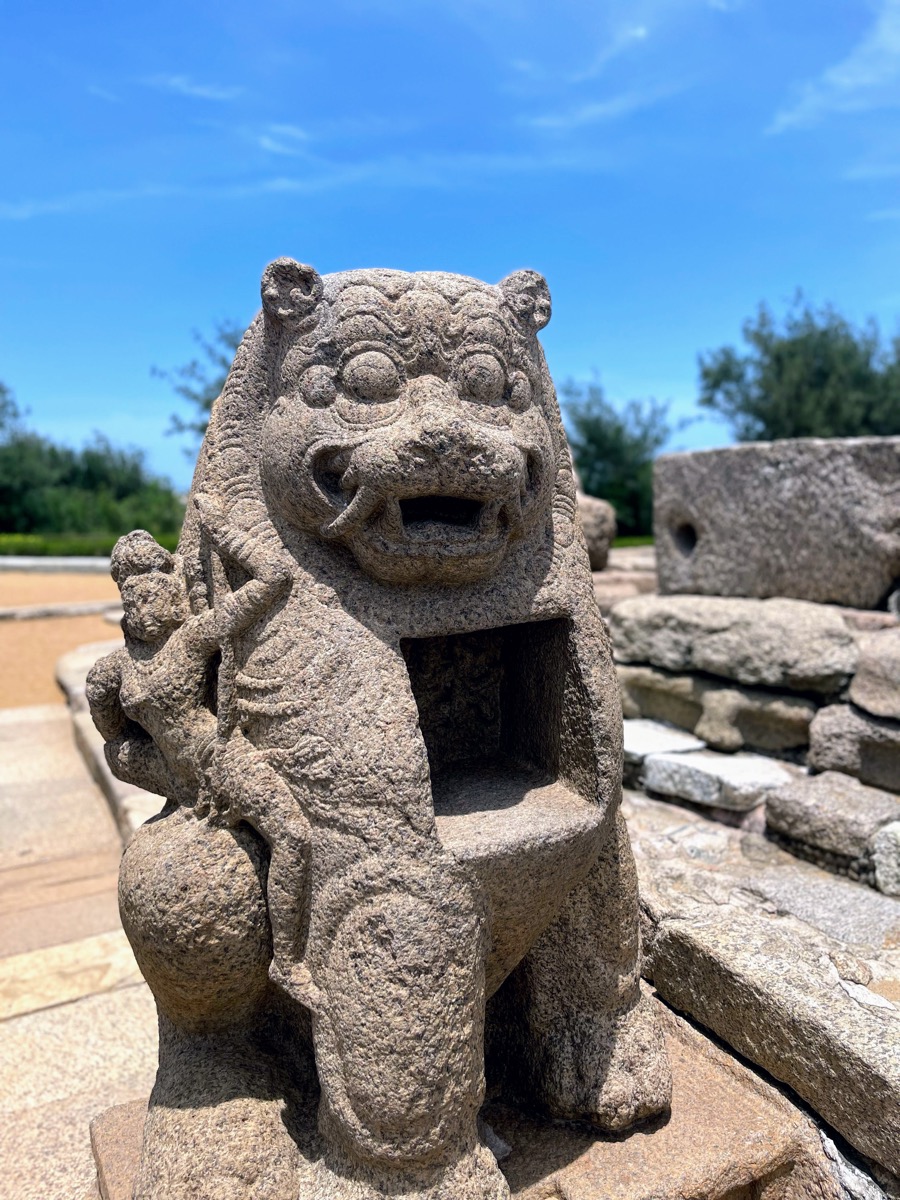
The earliest known Yali sculptures appear in Pallava-era temples at Mamallapuram and Kanchipuram. The Pallava sculptors were establishing the grammar that the Cholas would later speak fluently — composite, fierce, and encoded with protective purpose.

Shore Temple, Mamallapuram · Kailasanathar Temple, Kanchipuram
9th – 13th Century CE
The Chola Empire

Under Raja Raja Chola I and Rajendra Chola I, the Yali reaches its fullest architectural expression. The Brihadeeswara Temple at Thanjavur (1003–1010 CE) represents the peak — colossal granite guardians proportioned to the Talamana system and encoded with the full symbolic vocabulary of the Shilpa Shastra. This is the world of The Yali Code.

Brihadeeswara, Thanjavur · Gangaikondacholapuram · Airavatesvara, Darasuram
14th – 16th Century CE
The Vijayanagara Empire

The Vijayanagara Empire transforms the Yali into a structural and decorative element of extraordinary scale. The famous rearing Yali columns of Hampi — each carved from a single granite block, each unique — represent the creature at its most kinetic and dramatic. The Vitthala Temple's 56 musical pillars, each tuned to a Carnatic note, are the most studied example of acoustic temple architecture in South India.

Vitthala Temple, Hampi · Hazara Rama Temple, Hampi
16th – 18th Century CE
The Nayaka Period

The Nayaka rulers push the Yali to its most ornate expression. The thousand-pillared halls of Madurai's Meenakshi Amman Temple contain Yali columns of extraordinary detail — the creature now rendered with jewellery, decorated surfaces, and a refinement that reflects a civilisation at the height of its decorative ambition. The Ramanathaswamy Temple corridor at Rameswaram stretches 197 metres, lined with Nayaka-era Yali columns.

Meenakshi Amman Temple, Madurai · Ramanathaswamy Temple, Rameswaram
← Back to The Yali Code
Iconography

The Known Forms of the Vyāla

Vastu Shastra recognises 16 distinct types of Vyāla (Yali), each with a specific architectural and symbolic purpose. The five forms described below are the most architecturally significant and frequently encountered in South Indian temples. Of these, only the Simha-Vyāla appears as a central figure in The Yali Code.

The known forms include: Simha (lion), Gaja (elephant), Ashva (horse), Nara (human), Shvana (dog), Mrga (deer), Varaha (boar), Pakshi (bird), Sarpa (serpent), and further composite forms incorporating rhinoceros, ibex, and other animals.

The Five Principal Forms

★ Simha-Vyāla — The Lion Form
Lion-headed, lion-bodied. The temple's primary protector, positioned at entrances and pillar bases. Represents royal courage and divine authority. The only form that appears as a central figure in The Yali Code.
function: primary_guardian // entrance_protection
Gaja-Vyāla — The Elephant Form
Elephant-headed on a lion's body. The most commonly occurring Yali motif in South Indian temples. Represents accumulated wisdom combined with power.
function: wisdom_amplifier // knowledge_guardian
Ashva-Vyāla — The Horse Form
Horse-headed on a lion's body. The messenger form — representing speed and the transmission of divine will. Found at transitional points in temple architecture.
function: transition_guardian // divine_messenger
Nara-Vyāla — The Human Form
A smiling human face on a lion's body, depicted standing upon a defeated demon. The protector of Dharma and knowledge. The most philosophically significant of all Yali forms.
function: dharma_keeper // conscience_guardian
Mrga-Vyāla — The Deer Form
Deer horns on a lion's body. Combines graceful agility with power. Represents a guardian that anticipates, adapts, and responds. The rarest of the commonly encountered forms.
function: adaptive_intelligence // strategic_response
The Other 11 Types
Shvana (dog), Varaha (boar), Pakshi (bird), Sarpa (serpent), and several others including forms incorporating rhinoceros and ibex features. Each encodes a specific function within the sacred architectural programme.
// 16 forms total · full canon not yet documented
← Back to The Yali Code
Language

The Sthapathi's Lexicon

The Yali Code draws on Tamil, Telugu, and Sanskrit — the three languages of its world. Every significant term is listed below with meaning, pronunciation guide, and the context in which it appears in the novel.

Architecture & craft

Sthapathi (stha-PA-thi)Sanskrit: the master architect-sculptor-engineer of the Dravidian tradition. Not a craftsman — a hereditary keeper of the Shilpa Shastra. The Sthapathi does not merely build; they encode. Kalahasta holds this title.
Shilpa Shastra (SHIL-pah SHAHS-trah)Sanskrit: the canonical texts governing temple architecture — proportions, iconometry, acoustic design, spatial orientation, and sacred geometry. The Brihadeeswara was built to these specifications.
Talamana (tah-lah-MAH-nah)The Shilpa Shastra system of iconometric measurement based on the palm of the hand (tala), divided into angulas. Every sculpture's proportions carry specific encoded meaning under this system.
Vimana (vi-MAH-nah)Sanskrit: the main tower of a Dravidian temple rising above the sanctum. The Brihadeeswara's vimana stands 66 metres — the tallest in South India. Conceived as a representation of Mount Meru.

Mythology & philosophy

Yāli / Vyāla (YAH-lee / VYAH-lah)Tamil / Sanskrit: the composite guardian creature — lion body, elephant trunk, sometimes equine or avian features. The name derives from roots meaning "fierce" or "monster." Recognised in 16 forms by Vastu Shastra.
Mānava (MAH-nah-vah)Sanskrit: "the human one" — a person who acts with compassion, wisdom, and restraint. The novel's moral framework positions this not as weakness but as the harder, more disciplined choice.
Asuran (ah-SOO-ran)Tamil/Sanskrit: the demonic principle — not a supernatural being, but a quality of character: cruelty, pride, the hunger for power over others. In the novel, Asuran behaviour is always a choice, not a destiny.
Dharma (DHAR-mah)Sanskrit: duty, righteous conduct, the moral law. In the novel's world, each character carries multiple, often conflicting Dharmas — sculptor, parent, subject, maker. The tragedy is when these codes cannot all be honoured at once.

History & geography

Chola (CHO-lah)The Tamil dynasty that ruled much of South India from the 9th to 13th century CE, reaching its zenith under Raja Raja Chola I and Rajendra Chola I. Capital: Thanjavur. The primary empire of The Yali Code.
Vengi (VEN-gi)The Eastern Chalukya kingdom of Telugu-speaking lands (modern Andhra Pradesh). Allied with the Cholas through the "dynastic knot" of marriage and politics. Vishwan's homeland in the novel.
RajamahendravaramCapital of the Vengi Kingdom. Named after Rajendra Chola I. Modern-day Rajahmundry, Andhra Pradesh. One of the two kingdoms whose alliance drives the novel's political architecture.
KaruvelapattanamFictional: the dark fortress of the warlord Durjaya. Located at the boundary of the Chola and Vengi territories — the novel's primary site of crisis.
← Back to The Yali Code
Research

The Chola Temple Circuit

Every detail in The Yali Code was walked, photographed, and felt in person. These temples — their stone, their silence, their geometry — shaped the story before a single word was written.

Temple Circuit — Photo Gallery
🏯
Brihadeeswara
Thanjavur
// photo pending
🏯
Airavatesvara
Darasuram
// photo pending
🏯
Gangaikonda­cholapuram
// photo pending
🏯
Kumbakonam
Temple Cluster
// photo pending
🏯
Vitthala Temple
Hampi
// photo pending
🏯
Meenakshi Amman
Madurai
// photo pending

// To add photos: replace each placeholder div with <img src="assets/temples/filename.jpg" style="width:100%;height:100%;object-fit:cover;">

Primary Settings

Brihadeeswara Temple, Thanjavur
Built by Raja Raja Chola I, 1003–1010 CE. The primary setting of the novel. 66-metre vimana tower. Constructed entirely from granite without mortar. UNESCO World Heritage Site.
Airavatesvara Temple, Darasuram
Built by Rajaraja Chola II, c. 1150 CE. The temple whose steps produce musical notes when struck. Referenced directly in the novel's worldbuilding.

Research Sites

Gangaikondacholapuram
Built by Rajendra Chola I, completed 1035 CE. Referenced in the novel as a symbol of Chola ambition and reach.
Kumbakonam Temple Cluster
Multiple Chola-era shrines. Studied for Yali variations and the density of temple culture in the Chola heartland.
Vitthala Temple, Hampi
The 56 musical pillars — each tuned to a different Carnatic note. The most documented acoustic temple architecture in South India.
Meenakshi Amman Temple, Madurai
Nayaka period. The thousand-pillared hall with Yali columns at their most ornate.

// Full photo essay coming after publication. Sign up to be notified.

← Back to The Yali Code
The Author

The Full Author Story

"I did not set out to write a novel. The Yali Code arrived the way most important things in my life have — quietly, then all at once."

The builder who became a writer

I am not a historian. I am a founder. I have spent the last fifteen years building technology businesses — Autorox and Autozilla, software platforms now serving thousands of auto repair workshops across more than thirty countries. My days are filled with code, customers, factories, and the practical complexities of running operations in markets stretching from Hyderabad to Dubai to West Africa.

Writing fiction was never the plan. The Yali Code became the plan because the question at its centre refused to leave me alone.

The temple that started everything

It began at a temple I had visited many times before — the Brihadeeswara at Thanjavur, built by Raja Raja Chola I between 1003 and 1010 CE. On that particular visit, I stood beneath a Yali I had walked past a dozen times and could not move. There is no good word for what I felt. The closest is recognition. Something in that stone had been made, the way you make a system to solve a problem — not the way you decorate a wall.

I started researching the next morning. I have not stopped since.

The two worlds I live in

I straddle two worlds that most people consider unrelated. In one, I work with engineers building modern AI-driven systems — recommendation engines, prediction models, autonomous diagnostic tools. In the other, I sit with priests, sthapathis, and historians who carry the inheritance of a craft tradition older than any company I have ever built. What I came to understand — slowly, and against my own initial scepticism — is that these two worlds are asking exactly the same questions. Just in different materials.

Why this story, now

Every era believes its dilemmas are new. AI ethics. The responsibility of creators. The question of what intelligence we build, and who gets to decide what it does. These are the loudest debates of our time. They were also, I have come to believe, the loudest debates of the Chola era — except they were not debated in policy papers or congressional hearings. They were carved in granite. We just stopped reading the carvings.

The Yali Code is my attempt to read them out loud.

Roots in Andhra, story across South India

I am a son of Andhra Pradesh, with deep family roots in the Telugu speaking lands that medieval historians knew as Vengi. The Yali Code is set across both the Chola heartland and the Eastern Chalukya kingdoms — the Tamil and Telugu worlds woven together as they actually were in the 11th century, through marriage, trade, art, and the slow exchange of ideas. This book is, among other things, my small gift back to the civilisation that produced me.

What comes next

The Yali Code is Book One of The Eternal Shield Trilogy. I am already deep into Book Two. There will be three. Each one is built around a different question that South Indian civilisation answered first — and that the modern world is rediscovering the hard way.

If any of this resonates with you, I would be glad to have you walking with me through the trilogy. The first chapter of Book One is free — sign up below and I will send it.

← Back to The Yali Code