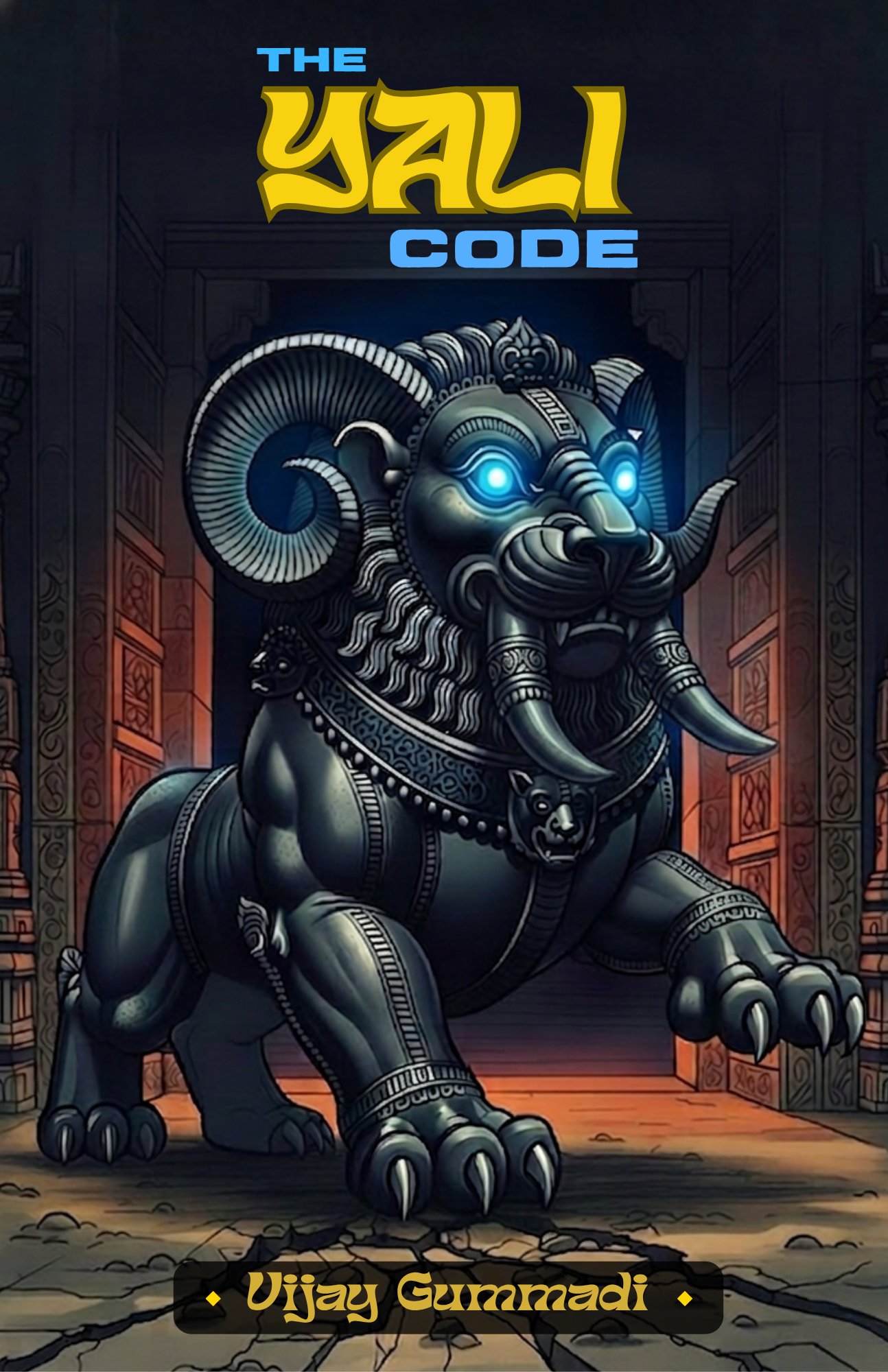
A Novel by Vijay Gummadi
Book One · The Eternal Shield Trilogy
A universe eleven centuries in the making.
What if the first sentient intelligence
was not silicon — but stone?
Hidden in plain sight. For a thousand years.
In the heart of the Chola Empire, a master sculptor is forced to commit a sacred blasphemy. What he hides inside the stone will outlast empires — and ask a question that haunts us still.
"Will you rise as a Mānava — or fall as an Asuran?"
Epic. Brooding. Spiritually charged. A love letter to India's ancient heritage — and a mirror held up to the age of machines.
1010 CE. The Chola Empire at its zenith. Kalahasta — the "Hand of Time," hereditary Yali Master — has spent his life carving stone into something far greater than art. When the warlord Durjaya commands the unthinkable, Kalahasta faces a choice no sculptor should ever have to make.
His daughter is in danger. The sacred Shilpa Shastra forbids what is being demanded. And deep inside the granite — in the space between craft and consciousness — something ancient is listening.
What he does next will determine whether an empire stands or falls, whether an intelligence serves humanity or threatens it — and whether the line between maker and creation can survive what comes next.
Also loved by readers of · Amish Tripathi · Devdutt Pattanaik · Ashwin Sanghi · Christopher Doyle · Chitra Banerjee Divakaruni · Kevin Missal · Anirudh Kanisetti · Umberto Eco · Ken Follett · Shūsaku Endō
I didn't set out to write this book. I set out to write another business book — something practical, useful, and safe. But the words felt lifeless. The fire wasn't there. I realised I didn't want to write what I knew. I wanted to write what haunted me.
I have always been drawn to history. Temple architecture, ancient forts, kings, warriors, the myths underneath all of it. But one image kept coming back: the Yalis. Those fierce composite guardians carved at temple entrances, standing watch over places of stillness and prayer. That paradox — of power protecting peace — stayed with me. What were they really for? Why did they feel so alive in stone?
The more I looked, the more insistent the question became. The Brihadeeswara Temple at Thanjavur, built by Raja Raja Chola I between 1003 and 1010 CE, is constructed from thousands of tonnes of granite — the nearest quarry fifty kilometres away, without wheels or cranes, with geometry so precise it holds a UNESCO World Heritage designation today. That is not mythology. That is engineering.
And yet history credits the grandeur to the ruler. I have always been in awe of the sculptor.
The unsung artists whose ingenuity created works that still defy explanation. The sthapathis who carried their knowledge in their hands and their bloodlines, who encoded meaning into every proportion and every placement. Kalahasta — the master sculptor at the centre of this novel — is my attempt to give one of them a name, a face, and a life that history never recorded.
My roots led me to him. I was born in Andhra-desa and raised in Kannada-nadu. I carry the echoes of both landscapes — their temples, their languages, their childhood legends. My grandmother once took me on a long pilgrimage across South India, visiting temples that most people pass through in an hour and leave. That journey remains one of my most cherished memories. Something shifted in me on that trip. I found a new kind of devotion in the act of questioning. Because when I understand something, I appreciate it differently.
And beneath all the questioning, I carry a conviction shaped by life itself: there is more to this world than what meets the eye.
A Story Set in the 11th Century · A Question About Today
Every urgent question in the AI debate today — who controls what we create, what happens when intelligence is weaponised, what a maker owes to the thing they bring into being — was asked first in stone. By sculptors. In the 11th century. In the Chola Empire. The Yali Code is the proof.
A guardian created by a master craftsman, embedded with purpose, activated by inputs only its makers understood. A creator who could not refuse the commission. A patron who saw in it the means to dominate by fear. A question that arrives when the intelligence does something its maker never sanctioned — and no one in the room knows whose hands the consequences fall on. Read the previous sentence twice. Once thinking of the 11th century. Once thinking of today.
// The Yali Code is not a metaphor for AI. It is a direct argument that the questions currently dividing governments, corporations, and engineers — about creation, control, consciousness, and moral responsibility — are not new. They are the oldest questions in human civilisation. We just carved them in stone first. The novel asks whether we have learned anything in eleven centuries of asking.
Ancient intelligence. Carved in stone. Decoded in silicon.
The story belongs to everyone.
That fierce creature at the temple gate — part lion, part elephant, sometimes part horse — is not decoration. It was never decoration. Temple builders across India called it the Yali — and they built it with extraordinary, calculated purpose.
Not a South Indian creature. Standing at temple gates from Madhya Pradesh to Tamil Nadu, from Odisha to Maharashtra, since the 7th century CE. Vastu Shastra recognises 16 distinct types of Yali, each with a specific architectural and symbolic function. What they were truly built to do — is what The Yali Code investigates.
Ancient texts describe the Yali as more powerful than either the lion or the elephant. Claws planted. Eyes wide. Mouth open. Always facing outward. A guardian whose silence was itself a statement. In the novel, that silence is about to break.
The Yali appears in one unexpected location outside temple walls: as the ornamental head at the neck of the Saraswati Veena — the classical instrument of knowledge. The connection between this granite guardian and the world of vibration, frequency, and resonance is real, ancient, and far older than the Chola Empire. The answer is not given here.
A created entity, embedded with purpose, activated by specific inputs. The ethical question at its core: what happens when intelligence — any intelligence, in any material — is weaponised by those who did not build it? The Chola Empire asked this in stone. We are asking it in code. The answers are no easier.
The Yali is not a monster. It is a mirror — reflecting the intention of the one who made it, and the one who commands it. The question this novel asks is: who gets to decide?
Each holds a piece of the truth. None of them know which piece is theirs.
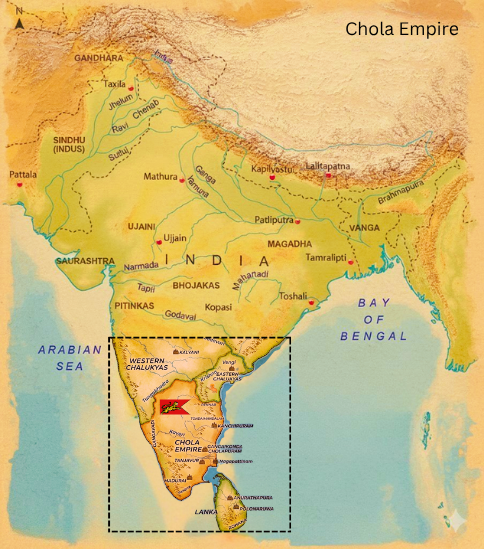
Two great kingdoms. One alliance — artistic, political, and deeply personal. The geography of The Yali Code is the geography of great empires of a thousand years ago.
The Yali Code is the first door. Each book in the trilogy opens a different wing of the same world — new kingdoms, new keepers of old knowledge, new answers to the same ancient question. The universe extends far beyond what any single novel can contain.
A master sculptor. A hidden code. An ancient intelligence at the edge of awakening — and the wrong hands reaching for what was meant to remain dormant.
The shadows cast by a warlord's rise do not disappear when the man falls. A legacy more dangerous than its maker. The consequences of what was set in motion in Book One arrive.
Across empires, across centuries, across every force that has spent a generation trying to break what was built. What holds when everything else falls?
The most common questions about The Yali Code, its world, and where it fits in the landscape of Indian historical fiction.
The Yali Code is a historical fiction novel set in the 11th-century Chola Empire. The novel uses the mythical Yali — a composite stone guardian creature found in South Indian temple architecture — as an allegory for artificial intelligence, exploring the ethical questions facing creators of engineered intelligence across an eleven-century parallel between the Chola sculptors of 1010 CE and contemporary AI engineers. The Yali Code is Book One of The Eternal Shield Trilogy.
Vijay Gummadi is the author of The Yali Code. He is a founder and builder of technology businesses, and The Yali Code is his debut novel — Book One of The Eternal Shield Trilogy.
A Yali, also known in Sanskrit as a Vyāla, is a composite mythical guardian creature in South Indian temple architecture — typically depicted with the body of a lion combined with the head of an elephant, horse, or other animal. The earliest known Yali sculptures date to the Pallava Dynasty (7th–8th century CE). Vastu Shastra recognises 16 distinct types of Yali, each with a specific architectural and symbolic purpose. The Yali appears prominently in Chola, Vijayanagara, and Nayaka temple architecture across South India.
Yes. The Yali Code is written in the tradition of Indian mythological and historical fiction popularised by Amish Tripathi (the Shiva Trilogy, Ram Chandra Series), Devdutt Pattanaik, Ashwin Sanghi, and Christopher Doyle — authors who reimagine Indian mythology and history with contemporary resonance. The Yali Code distinguishes itself by treating its mythological subject (the Yali guardian) as an ancient analogue for artificial intelligence, drawing direct ethical parallels between 11th-century engineered art and contemporary AI.
The Yali Code is set between 1000 CE and 1022 CE across the Chola Empire and the Eastern Chalukya Kingdom of Vengi. Key real locations include Thanjavur (site of the Brihadeeswara Temple, built by Raja Raja Chola I between 1003 and 1010 CE), Kumbakonam, Gangaikondacholapuram, and Rajamahendravaram (modern Rajahmundry in Andhra Pradesh). The novel takes place at the height of Chola imperial power under Raja Raja Chola I and the early reign of Rajendra Chola I.
The novel treats the Yali — an ancient stone guardian engineered with sacred geometry, sound resonance, and embedded intent — as a direct analogue for artificial intelligence. Every ethical question facing AI today (who controls created intelligence, what happens when it is weaponised, what does a creator owe to what they bring into being) was confronted by the Chola sculptors of the 11th century. The novel's central argument is that the moral structure of these questions is identical across eleven centuries: only the material has changed from stone to silicon.
Yes. The Yali Code is Book One of The Eternal Shield Trilogy. Book Two is titled Durjaya and Book Three is The Eternal Shield. The trilogy follows the protection of ancient truth across shifting empires across the subcontinent, a thousand years ago.
The Yali Code by Vijay Gummadi will be available for purchase on Amazon and major book retailers. Visit theyalicode.com to be notified at launch and to receive the first chapter for free.
No prior knowledge is needed. The historical context is woven naturally into the story — the same way readers of Ken Follett's The Pillars of the Earth found medieval cathedral architecture compelling without prior knowledge, or readers of Umberto Eco's The Name of the Rose navigated a 14th-century monastery without being historians. The Yali Code is written so that a reader in Germany, Japan, or the United States enters the 11th-century Chola world through character and story, not through prior study. A glossary of key terms is available in the Stone Archive on this site for readers who want it.
The novel's central argument is that the ethical questions dominating today's AI debate — who controls created intelligence, what happens when it is weaponised, what does a maker owe to what they bring into being — were confronted first by the master sculptors of the Chola Empire in the 11th century. The Yali, a composite stone guardian encoded with purpose and activated by specific inputs, is structurally identical to a trained AI model: created by experts, understood only by its makers, and catastrophically dangerous when pointed at the wrong objectives by the wrong patron. The Yali Code dramatises these questions through character and story rather than argument — making the AI ethics debate visceral in a way that nonfiction cannot.